
Product Carbon Footprint (PCF)

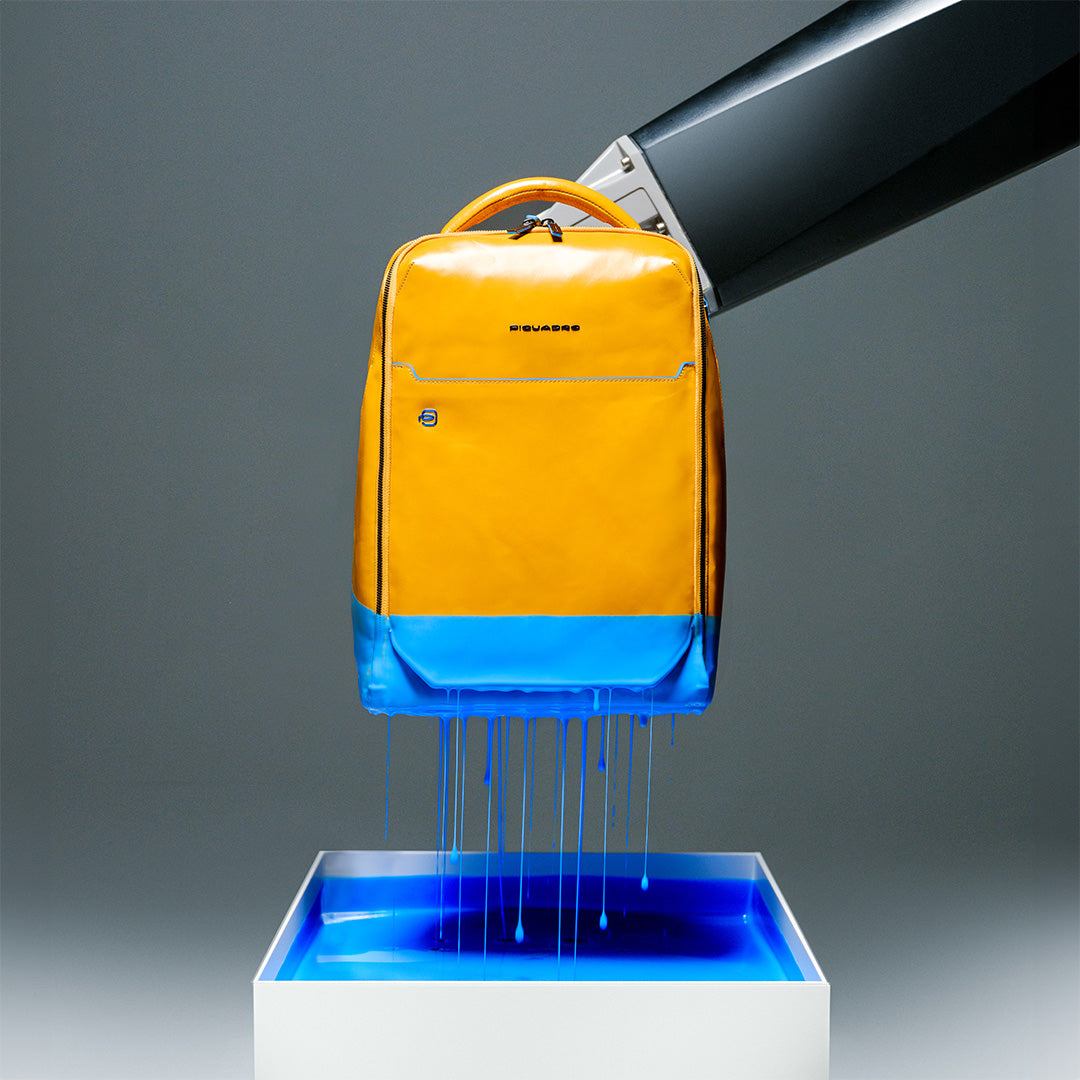
Recycled 15.6" Laptop Backpack for EasyJet Cabin Size

  • Product analysedCA6630S137
  • CollectionSS25
  • ReportACBC · January 2025
Recycled 15.6" Laptop Backpack for EasyJet Cabin Size
16.31 kg CO₂eqPer unit · ACBC estimate
01

Context and objectives

A product's carbon footprint is the total of the greenhouse gas emissions caused, directly or indirectly, over its whole life cycle: from the extraction of raw materials through manufacturing, transportation and packaging to its end of life. The analysis shows which stages and components weigh the most.

Piquadro commissioned the analysis from ACBC Srl (ACBC Sustainability Services). The report uses internationally recognised methods and scientific data to show where emissions can be reduced, for example in manufacturing processes and in the choice of lower-impact materials.

System boundaries

  • Raw materials
  • Manufacturing
  • Transportation
  • Packaging
  • End of life
  • Use phase excluded
02

CO₂ summary

Estimated greenhouse gas emissions for one unit of the product, in kg of CO₂ equivalent, split by life-cycle stage.

16.31 kg CO₂eqTotal, 10% tolerance included

  • 13.34 kg CO₂eqRaw materials81.8%
  • 1.82 kg CO₂eqManufacturing11.2%
  • 0.29 kg CO₂eqTransportation1.8%
  • 0.86 kg CO₂eqPackaging5.3%
  • 0.00 kg CO₂eqEnd of life0.0%

The total includes a 10% tolerance to cover gaps in the data. The values by stage add up to the total.

03

Product benchmark

Reference values that ACBC compares the product with in the report, in kg of CO₂ equivalent.

  • High impact leather goods
    48.23 kg CO₂eq
  • High impact non-leather goods
    22.19 kg CO₂eq
  • Low impact leather goods
    18.85 kg CO₂eq
  • Low impact non-leather goods
    15.45 kg CO₂eq
  • This model (CA6630S137)
    14.82 kg CO₂eq

In the comparison the report shows the model value before tolerance (14.82 kg CO₂eq), which is why it is lower than the total.

04

Where the impact comes from

The parts and materials of the product that contribute most to its footprint.

The most impactful categories

  • 35.76%
    Structures
  • 30.55%
    Reinforcements
  • 14.64%
    Lining

The most impactful materials

  • 35.76%
    polyamide
  • 11.17%
    Polyester (PL)
  • 7.9%
    Recycled polyester (rPL, rePET)
05

Responsible input (RI%)

Share of responsible inputs (recycled or lower-impact materials) in components and packaging, as calculated by ACBC.

  • 39.98%
    Components
  • 18.84%
    Packaging
  • 58.82%
    Total RI%
06

Assessment methodology

How ACBC calculated the figure, with the conditions stated for this model.

The assessment is based on

  • Internationally recognised standards (GHG Protocol, ecoinvent, Agrifoodprint)
  • Secondary data from scientific life cycle assessment databases
  • ACBC's primary data

Analysis conditions

  • Raw Materials: The analysis excludes material loss rates and wastage during production
  • Transportation: If specific transportation data are not provided, we adopt logically better, feasible, and more sustainable transport options for the calculations
  • Packaging: The impact of secondary packaging is not included in the analysis
  • Manufacturing: The impact related to manufacturing is calculated using energy consumption data as communicated by the providers. Where such data are not available, the country's energy mix is used to perform the analysis
  • Ocean and Road Transport: Both ocean freight and road transportation are considered for outbound logistics, based on the most sustainable options available

Product Carbon Footprint methodology

  • Standards compliance: the methodology adheres to the Greenhouse Gas (GHG) Protocol.
  • System boundaries: from raw materials to the end of life of the product, excluding the use phase.
  • Data collection: product composition, suppliers and origin of materials.
  • Component weighing: with Driwei and Bil2b Bombelli scales.
  • Emission factors: derived from the composition of the components; where the literature does not cover a process, ACBC develops an internal estimation method.
  • CO₂ impact calculation: including production waste; secondary data fill the gaps where direct data are missing.
  • Results documentation: in an official report.

Focus on data collection

  • ACBC aims at the highest possible data quality.
  • It uses primary data when available, collected directly with the parties involved.
  • It supports companies in collecting, documenting and comparing data.
  • It reduces data gaps as far as possible.
  • For unavoidable data gaps it suggests accounting for a 10% deviation of the PCF, so that the offset fully covers the emissions.
Download the PDF reportAll assessed modelsSource: Product Carbon Footprint report by ACBC Srl for Piquadro, January 2025. The PDF is the reference document.